



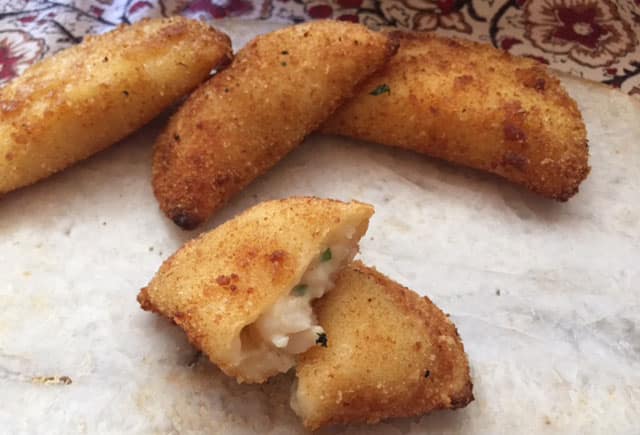


Looking for something different to serve for your next party? Portuguese Party Shrimp Rissoles are just the thing. Stepping away from the usual appetizers like stuffed mushrooms and scallops wrapped in bacon that I often encounter at social events, I like to serve up some Portuguese flavors.
Portuguese fare, often referred to as peasant food, has started to evolve with modern influences. When I was a child, my Portuguese family did not have appetizers or starters like there are today, except for a special holiday or party. What we enjoyed were usually created out of leftover braises, bits and pieces of fish or meat or small amounts of shellfish. Coming from a poor culture taught us to save every bit of food that could be made into something else or at least incorporated into another dish, such as the savory bites we call “petiscos.” Common petiscos include Pasteis de Bacalhau, fried oval-shaped codfish cakes of the Portuguese mainland, made of a mix of potatoes, salted codfish (bacalhau), eggs, and seasoning. Croquetes de Bacalhau are Azorean salted codfish croquettes, a fried, finger-length mix of salted codfish, seasoning, and thick béchamel. Rissóis (rissoles) are savory pastries filled with meat, game, poultry or codfish. As a child, my cousins and I would watch how my aunt, with a deft hand, would whip up rissóis in no time while we eagerly waited to “test” them for her.
Rissóis are one of the most popular petiscos and a perfect appetizer for a crowd. The rissoles of Portugal, according to oral history, have French influences. But rather than encasing the savory fillings with puff pastry, we Portuguese make these little turnovers with a “massa cozida” or cooked dough, similar to choux pastry, and coat them in breading. These can be served as a snack, part of lunch, or as party fare, but they are always present at Christmas. The most popular filling is shrimp, especially on Christmas Eve — but if you are not a shrimp lover, chicken, rabbit or other meats or fish work very well. Delectable rissoles can even be made with vegetables. A whisper of cilantro (parsley can be substituted) and a hint of heat from the optional hot sauce will break down one’s will power.
In this recipe the choux pastry uses milk, as did the one I was taught, but depending on where in Portugal they are made, some cooks instead incorporate the broth of the meat, chicken or seafood used in the filling. Milk gives the pastry a softer texture, broth will make it crispier. The trick of rolling the choux pastry is to keep it warm, otherwise you will need to flour the surface and rolling pin before you roll out the dough. I have baked rissoles, spraying them first with oil, but the frying gives them much more flavor. If you are not going to fry them the same day, these rissoles can be made up ahead and frozen.
Although not traditionally served with a dipping sauce, today you might serve seafood rissoles with spicy ketchup or cocktail sauce, and meat rissoles with a creamy cucumber, dill or cilantro sauce. Make them small or large, but definitely make them. You won’t be disappointed and neither will your guests.
Portuguese Shrimp Rissoles
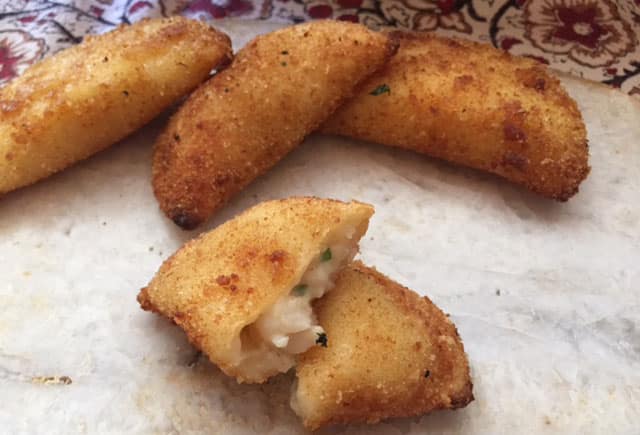
Rissóis de Camarão
Makes about 2 ½ to 3 dozen
Ingredients
For the filling:
- •30 ml (2 tablespoons) butter
- •60 ml (¼ cup) finely chopped onion
- •237 ml (1 cup) milk
- •7.5 ml (½ tablespoon) finely chopped cilantro or parsley
- •5 to 10 ml (1 to 2 teaspoons) hot pepper sauce, or to taste
- •2.5 ml (½ teaspoon) coarse salt or to taste
- •2.5 ml (½ teaspoon) ground white pepper
- •1.25 ml (¼ teaspoon) ground nutmeg
- •30 ml (2 tablespoons) cornstarch or flour
- •227 grams (8 ounces, about 1½ cups) peeled (shells reserved) and deveined, shrimp, cooked, well-drained, and coarsely chopped
For the pastry dough:
- •473 ml (2 cups) milk or broth (shrimp shells simmered in water 15 minutes then strained out)
- •57 grams (4 tablespoons) butter
- •5 ml (1 teaspoon) coarse sea salt
- •240 grams (2 cups) all-purpose flour
For assembly:
- •28 to 57 grams (2 to 4 tablespoons) soft warm butter
- •3 eggs, lightly beaten with 45 ml (3 tablespoons) water
- •Fine plain breadcrumbs


Preparation
For the filling: Melt the butter in a 946 ml (1-quart) saucepan. Add and fry the onion over medium-high heat until lightly golden, about 4 to 5 minutes.
Reduce the heat to medium-low, pour in the milk and heat to just scalding, not boiling. Stir in the cilantro, hot sauce, salt, pepper and nutmeg.
Combine the cornstarch with 30 ml (2 tablespoons) water and stir into the milk. Simmer, stirring constantly until it thickens, about 1 to 2 minutes. Do not overcook. Stir in the chopped shrimp, heat through for 1 minute, and remove from heat. Set aside to cool completely. The filling can also be made a day ahead and kept refrigerated until needed.
For the pastry dough: Combine milk or strained broth, butter, and salt in a 2 liter (2-quart) pot set over medium-high heat. Heat until scalding, not boiling. Reduce heat to medium-low.
Using a wooden spoon, vigorously stir the flour into the heated milk. Keep stirring until it pulls from the sides of the pot and forms a smooth dough. Remove pan from heat.
For assembly: While you can simply let the dough cool then roll out on a floured surface, cut discs, then fill and fold, the following method is what I like to use best. However for this method, it is important to use a warm surface like a wooden counter, a large cutting board, formica counter, or other warm non-stone cutting board.
Butter your work surface and dump the dough onto it. Using a light touch with a wooden or non-stick spatula, give the hot dough a few turns onto itself, kneading it briefly until fairly smooth. Do not overwork the dough. Divide the mound of dough in half, shaping each into a ball. Cover one of the balls on a separate cutting board with an inverted bowl to keep warm and reserve.
Shape the remaining ball of dough into a 10 to 12 cm (4 to 6 inch) diameter cylinder with the short end facing you. Using your warm rolling pin, without separating the dough from the cylinder, roll out enough of the short end of the dough towards you to about 12 cm (5 inches) in length and to .3 cm (1/8 inch) thick. Drop a scant 15 ml (1 tablespoon) of filling onto the center of the roll out. Fold the dough away from you, over the filling and press with your fingers to seal. Using an 8 cm (3-inch) diameter cutter, place it over the pressed edges but not the folded edge, cutting the rissoles into their half-moon shape. Any scraps can be re-folded into the cylinder.
Set aside the shaped rissoles on a lined tray. Working quickly to avoid the dough from cooling too much, repeat with all remaining dough. These can be made larger if desired, using a larger cutter and more filling. Once all the rissoles are formed, set up a bowl of egg wash and one of breadcrumbs. Dip each rissole, one at a time, into egg wash then coat with breadcrumbs, shaking off excess. Set back on tray without overlapping.
To cook, simply fry two to three at a time in hot vegetable or corn oil until golden. Serve hot or at room temperature. You can fry ahead, chill, then heat through in an oven if desired.
To freeze uncooked rissoles, set up a sheet pan with a sheet of plastic wrap extending over the edges, and a sheet of parchment paper on the plastic. Place breaded rissoles on sheet pan without overlapping them. Tightly double wrap with plastic wrap, then place into the freezer until needed. Once frozen, the rissoles can be transferred to a sealed plastic bag, but be sure to press as much air out as possible. These will keep up to 2 to 3 months. You can take out how many you need to fry for unexpected guests or cook them all up for a party. I usually remove frozen ones from the freezer about 15 minutes before frying them.
