



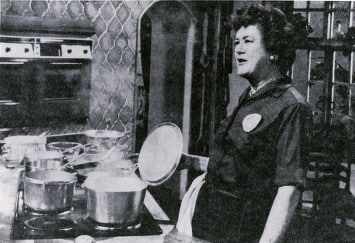


She sometimes swore a blue streak over dull knives.
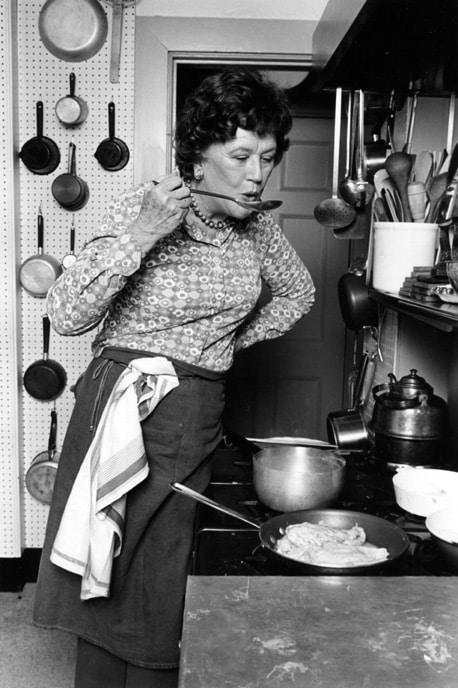
Julia Child is well-known in culinary circles. And well-documented in The American Masters series by filmmaker Marilyn Mellowes, director of American Masters: Julia Child! America’s Favorite Chef.
Scooping up a potato pancake, patting chickens, coaxing a reluctant soufflé, or rescuing a curdled sauce, Julia Child was never afraid of making mistakes. “Remember, if you are alone in the kitchen, who is going to see you?” she reassured her television audience. Catapulted to fame as the host of the series The French Chef, Julia was an unlikely star. Over 6′ 2″, middle aged and not conventionally pretty, Julia had a voice careened effortlessly over an octave and could make an aspic shimmy. She was prone to say things like “Horray” and “Yum, yum.” Her early culinary attempts had been near disasters, but once she learned to cook, her passion for cooking and her devotion to teaching, brought her into the hearts of millions and ultimately made her an American icon. To the fans who knew and loved her, she was known simply as Joooolia.
On camera, Julia’s presence was relaxed, reassuring and informal. But behind the unpolished quirky charm was a driven perfectionist, convinced that there was a right and a wrong way to do things.
Her pet peeve, dull kitchen knives, is an interesting story, as outlined by the NEHS:
In April 1951, while living in France, she was taken by an essay by Bernard DeVoto. In it, he railed against consumer rip-offs, particularly poor-quality household goods, particularly stainless steel knives. Months later, he repeated his tirade in a Harper’s magazine column. He went so far as to suggest kitchen knife manufacturers should be hauled before the House Un-American Activities Committee.
DeVoto criticized American-made stainless steel knives for their inability to hold an edge, and he detailed his continuing search for a carbon steel paring knife.
An excerpt from As Always, Julia: Letters of Julia Child and Avi DeSoto reads:
In “Crusade Resumed,” he revisited what he considered “the only mission I have ever set myself, that of trying to get for the American housewife a kitchen knife she can cut something with.” DeVoto criticized American-made stainless steel knives for their inability to hold an edge, and he detailed his continuing search for a carbon steel paring knife.
Julia initiated correspondence with DeVoto saying she thought he was “100% right” after reading his Harper’s Magazine critique of American kitchen knives, which resulted in a long friendship between Julia and his enterprising wife, Avis. The DeVotos lived in Cambridge, Massachusetts where Bernard was a historian and author, taught part-time at Harvard, wrote for influential periodicals and curated Mark Twain’s papers. His friend and biographer, Wallace Stegner described DeVoto as “flawed, brilliant, provocative, outrageous, … often wrong, often spectacularly right, always stimulating, sometimes infuriating, and never, never dull.”
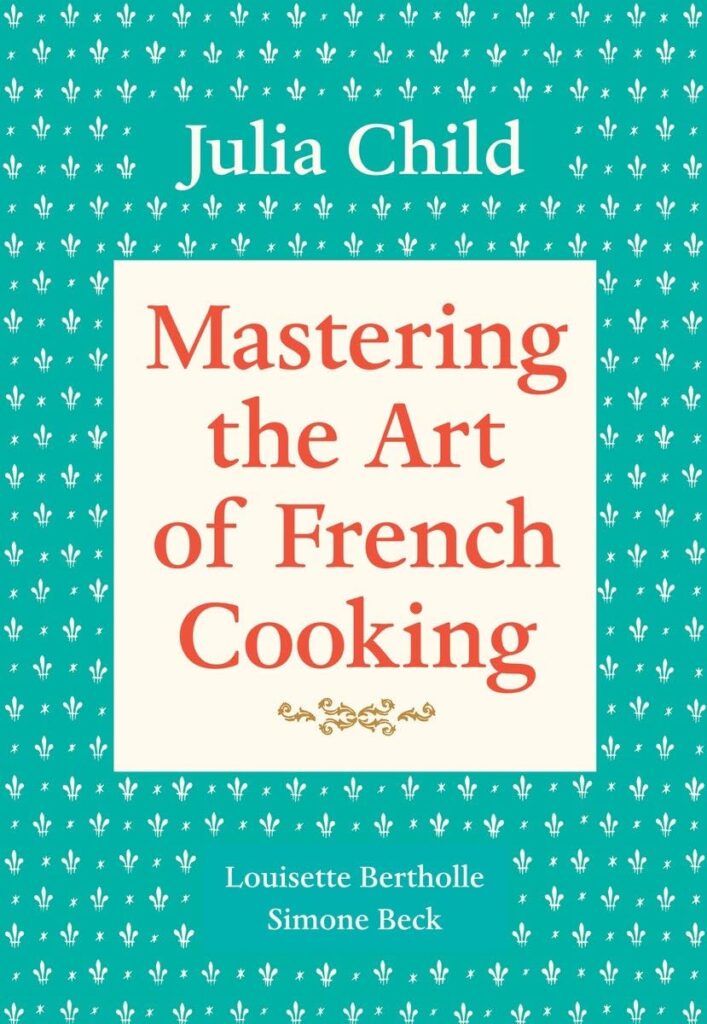
It began with a shared search for a perfect carbon steel kitchen knife.
Julia Child’s influence on generations of American women in the kitchen is exceptional and enduring. As an unlikely hero who championed fun and experimentation in the kitchen, we continue to look to her for inspiration and advice.
In Partnership with Shun Cutlery